Most beginner Bloons TD 6 guides die at the next balance patch because they are really tower-tier lists in disguise. This page is the opposite: three principles that hold on any map, at any difficulty, across any version, plus a practice path toward the modes that actually test you.
Principle one: economy before power
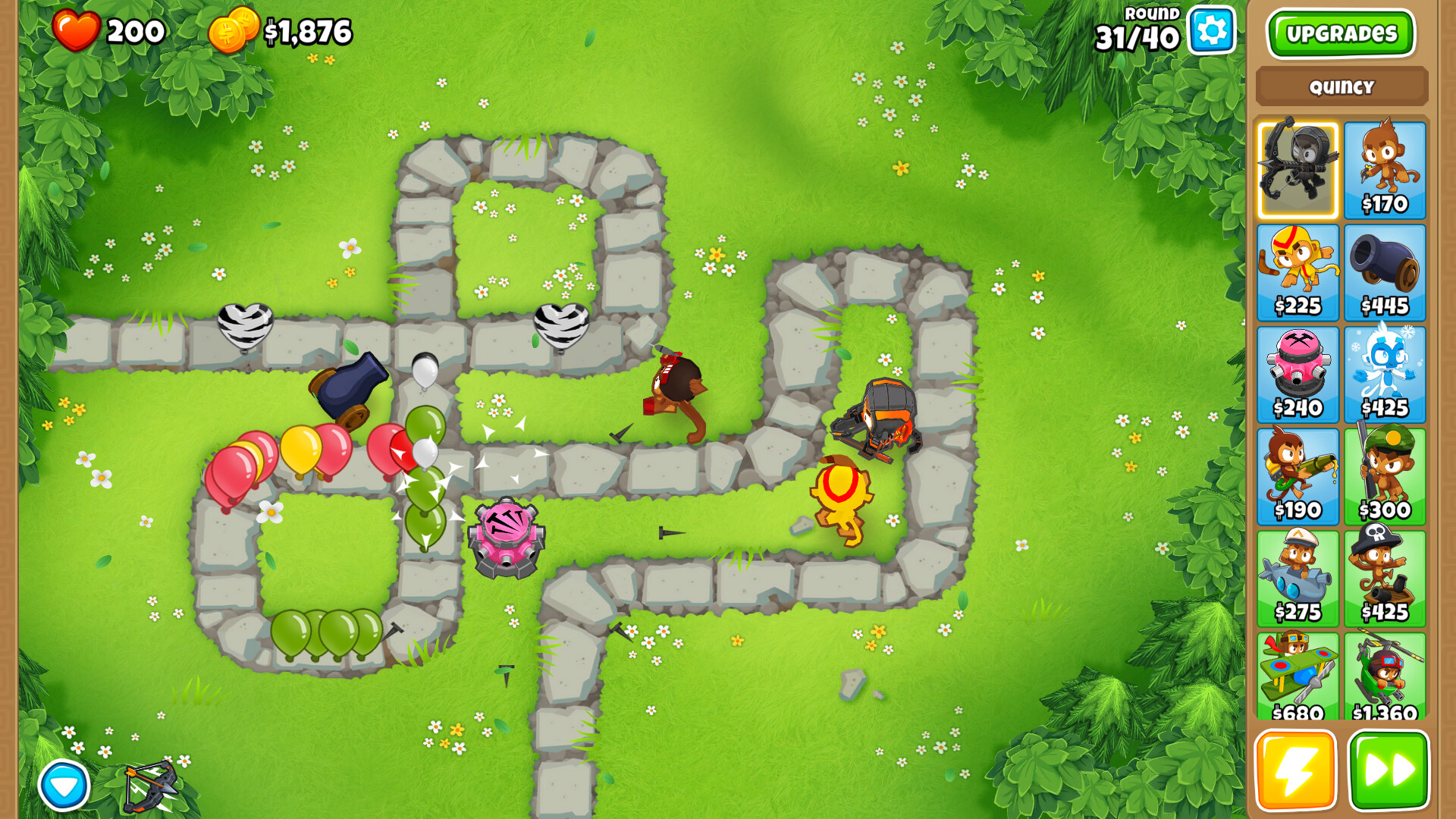
On the easier difficulty settings, the strongest early move is usually a money tower before more defense. A Banana Farm or equivalent pays for the rest of your build, and the window to buy one cheap is the early rounds. The discipline is deciding how much defense is enough to survive while the economy comes online, and that threshold moves with the map.
Principle two: coverage before specialization
New players stack three or four towers at the track's entrance and nothing past round forty. Bloons do not stop: camo and lead properties, fast bloon types and MOAB-class pressure all demand that something exists along the whole track and against each property. The framework: walk the track, name what handles each segment and each bloon property, and only then upgrade your best position.
Principle three: your hero patches your build's weakness
With seventeen heroes and one slot per game, the hero is your flex pick. If your build is slow, bring a hero that adds early damage. If your build is damage-rich but fragile, bring utility. The hero's automatic leveling means it rewards whatever role you assign it, so choose the role first.
How to practice toward hard modes
- Beat every standard difficulty on an Intermediate map before touching Expert maps.
- Learn one money strategy and one no-economy strategy on the same map; the contrast teaches what income actually buys.
- Enter CHIMPS-style discipline gradually: the restrictions on our modes page each remove a crutch, and the first games without selling feel like a different game.
- Use event modes as a classroom. Race Events show you what raw tempo looks like, and Boss Events teach damage stacking under a timer.
Watch: a beginner walkthrough
Prefer watching to reading? SJB's beginner guide walks through the game's front page, daily rewards, Heroes and the upgrade screens: the same onboarding ground this page covers, on video. It is a community video. The advice is the creator's, and where it touches numbers, our fact labels still apply.

FAQ
What is the best starting tower?
The Dart Monkey remains the honest answer for round one economics, but the deeper answer is that your first three towers should cover different bloon properties, not stack the same job. See the towers page for the class structure.
How do I get better at CHIMPS?
Lose on purpose, early and often. CHIMPS removes every safety net, so the skill it teaches is planning around what you cannot do. Start on maps you have already beaten at every standard difficulty (the ladder is on the modes page).
Should I buy Monkey Knowledge?
Monkey Knowledge meta-upgrades are free to earn and worth taking; just remember they are disabled in the hardest ruleset. They shape your early game, not your ceiling.